
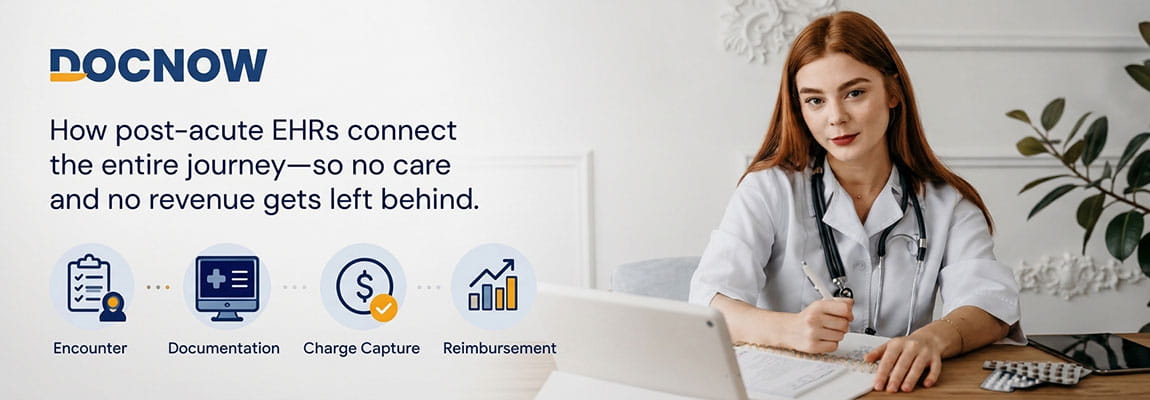
A wound care provider completes an encounter. The patient was seen. Care was delivered. The wound was assessed. The appropriate treatment was provided. So why can getting that encounter from the patient's room to the billing workflow still feel so complicated? For many long-term care facilities and wound care agencies, the problem is not the care itself. It is everything that happens around it.
A provider may be rounding across multiple facilities. A patient may require a follow-up assessment. Documentation may need to be completed. Charges need to be captured. Billing teams need the right information. Administrators need visibility into what was completed and what still needs attention.
When those pieces live in disconnected workflows, revenue can slip through the cracks. That makes the EHR much more than a place to store clinical notes. For organizations evaluating post-acute EHR systems for wound care, the bigger question is: Can your EHR connect the entire journey from encounter to charge capture?
The Revenue Cycle Starts Before the Wound Care Note
Charge capture does not begin when a provider selects a CPT code. It begins with the encounter itself. Before a provider sees a patient, the organization needs visibility into who requires care, where the patient is located, which provider is responsible, and what needs to happen during the visit. This becomes more challenging as wound care agencies expand across multiple skilled nursing facilities.
A provider may have a full day of rounds spread across several locations. New consults may be added. Follow-ups may be needed. Patients can be discharged or transferred. Without a connected workflow, it can be difficult to maintain a clear picture of what happened.
A strong post-acute EHR should help answer:
- Who needs to be seen?
- Which facility are they in?
- What type of encounter is needed?
- Was the encounter completed?
- Has the documentation been completed?
- Is anything still missing?
This is the first opportunity to protect revenue. If the encounter is not visible, it becomes much harder to ensure the encounter is captured.
Before the Encounter: Make Every Visit Visible
For wound care agencies, managing the patient list is only part of the challenge. The real challenge is managing the movement of providers, patients, facilities, and encounters.
An EHR designed around post-acute workflows should make that activity easier to see. DocNow approaches this through workflows built for providers who round across facilities. Instead of treating each patient chart as an isolated event, DocNow connects patient, provider, facility, and encounter information within the broader post-acute workflow.
That visibility can help teams identify rounding priorities and keep completed care connected to the next step in the process. For a wound care organization, that creates an important distinction: The workflow begins before documentation.
During the Encounter: Capture the Information That Supports the Service
Once the provider is with the patient, the focus shifts from scheduling and visibility to clinical care. The documentation needs to accurately reflect what happened. That includes the information needed to establish a clear clinical record and support the appropriate billing workflow.
For wound care, that may involve:
- Assessment findings
- Diagnosis information
- Measurements
- Treatment provided
- Procedures performed
- Medical decision-making
- Follow-up plans
- Supporting images
The goal is not to turn clinicians into billing specialists. The goal is to make sure the EHR captures the clinical information needed downstream without forcing providers to duplicate work. This is where the design of the workflow matters.
If the provider documents the encounter in one place, records the charge somewhere else, and then sends information to a separate billing system, every handoff creates another opportunity for delay or error. A connected EHR can reduce those gaps by bringing clinical documentation and charge capture into the same workflow.
Complete Documentation Is Part of Revenue Integrity
A missing field may seem like a small issue. Across hundreds or thousands of encounters, those small issues can add up.
Incomplete documentation can lead to:
- Additional billing review
- Delayed claims
- Manual follow-up
- Coding questions
- Missed charges
- Greater audit exposure
This is why documentation performance should be viewed as part of revenue integrity.
The question is not simply: "Did the provider finish the note?"
It is: "Does the completed documentation contain the information needed to support the care that was delivered?"
That distinction matters. A well-designed EHR should help clinicians complete documentation efficiently while giving organizations better visibility into incomplete or outstanding encounters.
After the Encounter: Can You See What Still Needs Attention?
This is where many workflows become disconnected. The provider finishes the visit. The clinical team sees the encounter as complete. But the billing team may still be waiting for information. An administrator may not know that documentation is incomplete. A charge may require review. Without visibility, these issues can sit unnoticed.
A strong wound care agency software platform should help teams see what happens after the encounter, not simply record what happened during it.
That means giving the right users visibility into:
- Completed encounters
- Incomplete documentation
- Outstanding charges
- Billing-related information
- Provider activity
- Facility activity
- Encounter trends
The benefit is simple: teams can identify gaps sooner instead of discovering them after the billing cycle has already moved on.
Where Missed Encounters Become a Revenue Problem
Consider a simple scenario. A provider is scheduled to see 20 wound care patients across three facilities. Nineteen encounters are completed. One patient is missed.
If the system does not clearly surface that missed encounter, the issue can easily become buried in a busy rounding schedule. The organization may lose the opportunity to identify why the encounter was missed, reschedule appropriately, document the eventual visit, or capture the associated service.
The problem is not necessarily the billing department. The problem started earlier in the workflow. That is why charge capture should be viewed as a connected process rather than a final billing task. Every captured charge starts with a visible, completed encounter.
Why Multi-Facility Visibility Matters
Wound care agencies and specialty providers often operate across multiple facilities. That creates a unique EHR challenge. A system may work perfectly well for one facility while becoming difficult to manage when the organization expands. Leaders need to see activity across locations without opening individual charts one by one.
They may want to understand:
- Which facilities have the highest wound care volume?
- Are encounters being completed consistently?
- Where are documentation gaps appearing?
- Are there recurring delays?
- Which providers have outstanding encounters?
- Are charges being captured consistently?
This type of visibility turns the EHR from a documentation repository into an operational tool. For growing wound care organizations, that distinction can be significant.
What Should Administrators Look for in a Wound Care EHR?
When evaluating post-acute EHR systems for wound care, it is easy to get caught up in feature lists. Instead, evaluate the workflow from beginning to end. Ask the vendor to demonstrate the entire journey.
Start with the encounter:
Can the system help providers identify who needs to be seen?
Follow it into documentation:
Can the provider complete the encounter without unnecessary duplicate entry?
Follow it into charge capture:
How does the completed encounter become a captured service?
Follow it into billing:
Where does the information go next?
Then look for the gaps:
Can administrators identify incomplete encounters, missing documentation, or other issues before they become larger problems?
A good EHR demo should not stop after the provider clicks "Save." The real test is what happens next.
How DocNow Connects the Workflow
This is where DocNow takes a different approach. DocNow is built for post-acute care workflows, connecting clinical documentation, provider rounding, charge capture, facility information, and operational visibility within one platform. For wound care teams, that means the workflow can extend across the entire encounter lifecycle.
Before the encounter:
Providers can work from organized patient and rounding information.
During the encounter:
Clinical information can be captured within the EHR workflow.
After the encounter:
Completed services and documentation remain connected to the operational and billing processes that follow.
That connected approach is particularly valuable for wound care organizations managing high encounter volumes across multiple facilities.
The Goal Is Bigger Than Faster Documentation
Faster documentation is valuable. But faster charting by itself does not solve every revenue problem. A provider can finish a note quickly and still have an incomplete encounter workflow. A charge can be entered accurately and still be delayed because the underlying documentation is missing. A billing team can work efficiently and still struggle if the information they need is scattered across multiple systems. The bigger opportunity is to connect the pieces.
Before:
Identify the right patients and encounters.
During:
Document the care delivered.
After:
Make completed encounters and supporting information visible for charge capture and billing.
That is a revenue integrity workflow.
A Better Way to Think About Wound Care Charge Capture
Wound care charge capture should not be treated as a final administrative step. It is the result of everything that happens throughout the encounter lifecycle.
When the right patient is identified, the encounter is completed, the care is documented, and the appropriate information reaches the billing workflow, organizations have a much clearer path from care delivered to reimbursement. That is the opportunity for modern post-acute EHR systems for wound care. And it is where DocNow fits.
Rather than adding another disconnected tool to an already complicated workflow, DocNow is designed to bring the clinical and operational pieces closer together. Because the best charge capture process does not begin with a charge. It begins with making sure the care happened, the encounter was captured, and the story of that care is complete.


