

Managing patient census sounds simple on paper. You admit patients, track where they're receiving care, document encounters, and discharge them when appropriate.
In reality? It's one of the most challenging operational processes in post-acute care.
For organizations managing patients across multiple skilled nursing facilities, long-term care communities, assisted living centers, or wound care programs, census management becomes much more than keeping a patient list up to date. It directly impacts clinical workflows, provider productivity, billing accuracy, communication, and leadership visibility.
Unfortunately, many organizations are still relying on disconnected systems, spreadsheets, or legacy post-acute EHR software that wasn't designed for today's mobile clinical teams.
Let's take a closer look at why census management is so difficult and what healthcare organizations should expect from modern electronic health records.
Why Census Management Is More Complex in Post-Acute Care
Unlike a traditional hospital where patients remain in one location, post-acute providers often care for patients spread across dozens or even hundreds of facilities.
Providers may round at several buildings in a single day while documentation teams, billing staff, and administrators work remotely from different locations.
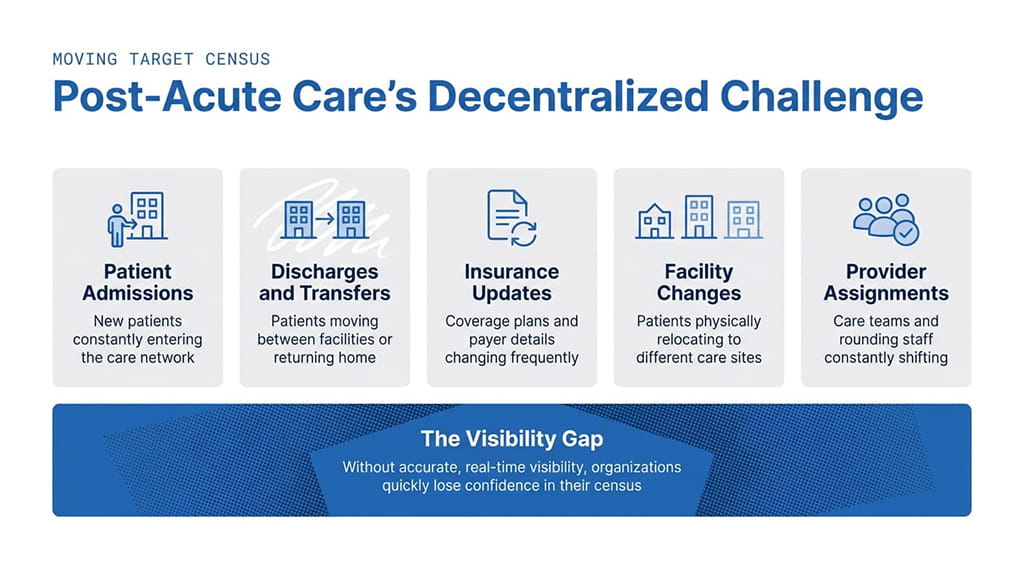
The Biggest Census Management Challenges
1. Admissions and Discharges Change Constantly
Every admission or discharge affects multiple workflows. Even small delays in updating patient information can ripple across the entire organization. When census updates aren't reflected immediately, providers may:
- Miss newly admitted patients
- Continue documenting on discharged residents
- Lose valuable clinical time verifying patient lists
- Create documentation errors that delay reimbursement
2. Multiple Facilities Create Multiple Sources of Truth
Many physician groups and specialty practices work across numerous post-acute facilities.
If each facility maintains its own census or updates information differently, staff often spend valuable time reconciling conflicting data. Instead of focusing on patient care, teams spend hours managing administrative work.
Common issues include:
- Duplicate patient records
- Outdated room assignments
- Incorrect provider assignments
- Missing patient information
- Manual spreadsheet tracking
3. Documentation Depends on Accurate Census Data
Clinical documentation starts with knowing which patients require care. Accurate documentation begins with an accurate patient census.
If the census isn't accurate:
- Providers waste time searching for patients.
- Visits may be missed.
- Documentation may occur under the wrong encounter.
- Charge capture can be delayed.
- Quality reporting becomes less reliable.
4. Care Coordination Becomes More Difficult
Effective post-acute care depends on communication between physicians, nurse practitioners, wound care specialists, therapists, facility staff, and administrative teams.
When everyone is working from different patient lists, communication breaks down. Without centralized visibility, teams spend more time tracking information than delivering care.
Questions like these become common:
- Has this patient already been seen?
- Who is assigned to this resident?
- Was documentation completed?
- Has the patient's status changed?
5. Leadership Lacks Real-Time Visibility
Administrators and healthcare IT leaders rely on census data to understand operational performance. Reliable operational decisions depend on reliable census information.
When data isn't current, leadership struggles to answer critical questions like:
- How many active patients are we managing today?
- Which facilities have the highest volume?
- Where are providers spending the most time?
- Are workloads balanced across clinicians?
- Which locations require additional resources?
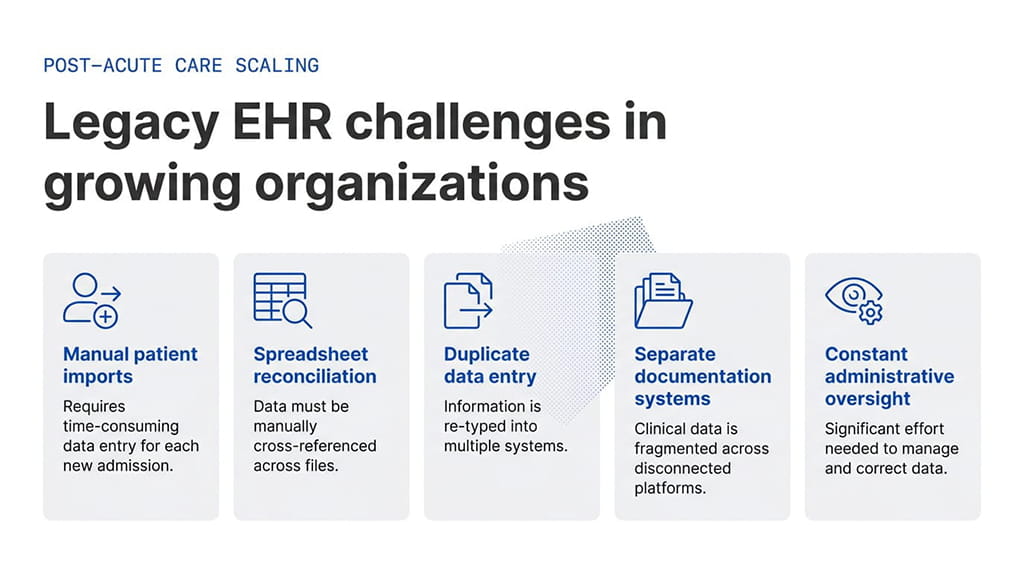
Why Legacy EHR Systems Make Census Management Harder
Many legacy electronic health records were originally built for static clinical environments not mobile post-acute workflows. Instead of simplifying operations, they create additional work.
These are some of the most common EHR challenges organizations face as they scale across multiple facilities.
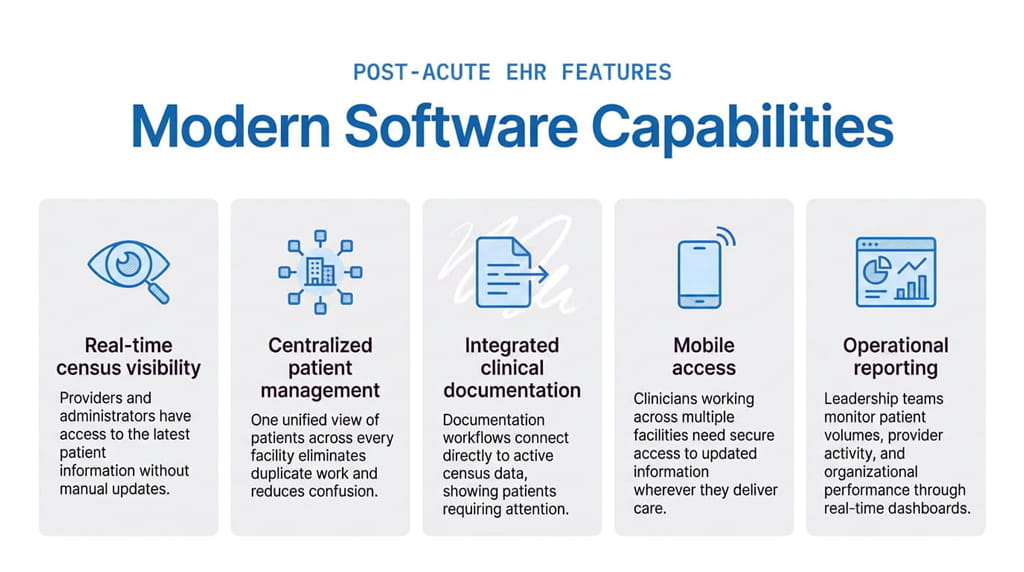
What Modern Post-Acute EHR Software Should Deliver
Today's healthcare organizations need technology that keeps pace with changing patient populations not systems that require constant manual maintenance.
How DocNow Helps Simplify Census Management
DocNow was purpose-built for the realities of post-acute care, helping physician groups and specialty practices manage patients across multiple facilities while keeping clinical teams connected through a centralized platform.
With integrated census management, documentation workflows, mobile access, and real-time operational visibility, providers can spend less time tracking patient information and more time delivering care.
Rather than forcing organizations to adapt to outdated workflows, DocNow supports the fast-moving nature of post-acute care with technology designed specifically for the environment clinicians work in every day.
Explore DocNow with a personalized demo and see how its census management and workflow features help teams work more efficiently every day.
Better Census Management Leads to Better Care
An accurate census is more than an administrative task but the foundation for efficient clinical operations.
When providers know exactly who needs care, administrators have confidence in their data, and leadership has real-time visibility into operations, organizations can improve productivity, strengthen care coordination, and support better patient outcomes.
As post-acute organizations continue to grow, choosing post-acute EHR software built specifically for this care setting can make the difference between constantly chasing patient information and confidently managing it.
If your organization is evaluating new healthcare software, census management should be one of the first capabilities on your checklist. The right platform won't just help you keep track of patients but help your entire organization work smarter.
Ready to Get Started?
DocNow Post-Acute EHRs is live and ready to simplify your prescribing. If you're a DocNow customer, it's time to see how easy prescribing can be.
REQUEST A DEMO


