
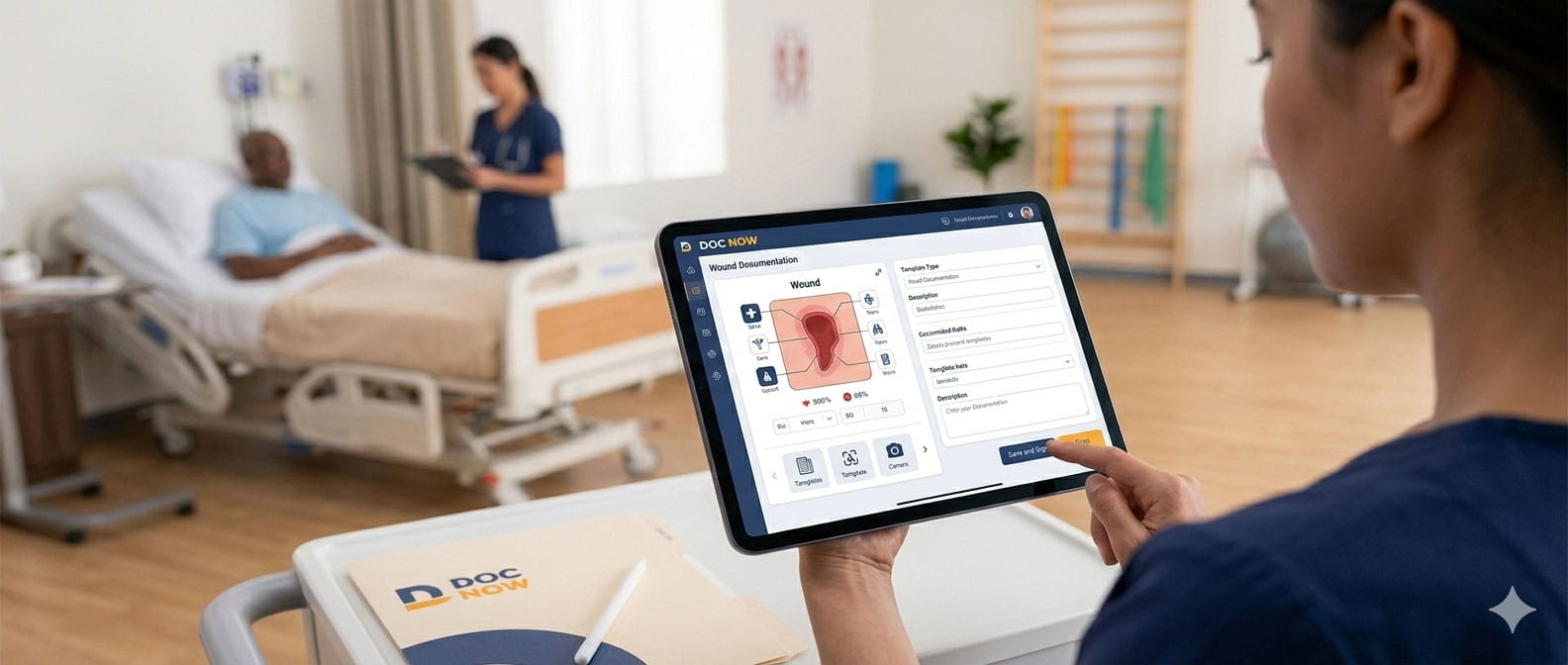
Wound care notes in long-term care are repetitive, detailed, and time-sensitive. Clinicians need to document wound location, measurements, tissue type, drainage, photos, treatments, orders, follow-up plans, and billing details, often while rounding across multiple skilled nursing facilities.
That is exactly where a purpose-built post-acute EHR can help. The goal is not just faster typing. The goal is wound care documentation efficiency without losing clinical detail, compliance visibility, or continuity between the provider, facility, billing team, and care partners.
Here are ten EHR capabilities that can reduce documentation time while supporting long-term care rounding, skilled nursing facility (SNF) mobile charting, and multi-facility clinician workflows.
1. Mobile Charting at the Bedside
Wound care documentation is fastest when clinicians can chart where care happens. A mobile-first post-acute EHR lets providers document at the bedside instead of taking notes on paper and re-entering them later.
For SNF mobile charting, look for:
- Secure mobile access
- Fast patient lookup by facility
- Wound-specific fields
- Photo upload from the same workflow
- Sync between mobile and desktop views
This reduces duplicate work and helps notes get completed closer to the actual encounter.
2. Facility-Based Census Lists
Long-term care rounding rarely happens one patient at a time. Clinicians move through a facility census, then repeat that pattern across multiple buildings.
A strong post-acute EHR should organize patients by facility, provider, rounding date, and care need. That makes it easier to see who needs a wound follow-up, who has an unsigned note, and which residents require updated documentation.
For administrators, this matters because better census organization reduces missed visits, late notes, and end-of-day cleanup.
3. Wound-Specific Templates
Generic EHR templates slow wound care teams down because they force clinicians to work around irrelevant fields. Wound-specific templates speed up documentation by structuring the note around the actual clinical workflow.
A useful wound template should capture:
- Wound type and location
- Stage or severity where applicable
- Measurements
- Tissue characteristics
- Drainage and odor
- Periwound condition
- Treatment plan
- Follow-up interval
- Clinical decision-making
Structured templates also support more consistent documentation across providers and facilities.
4. Carry-Forward Fields With Review
Many wound notes involve updating prior findings, not starting from scratch. Carry-forward fields can save time by pulling in the last wound assessment, measurements, treatment plan, and common phrases.
The key is controlled carry-forward. Clinicians should be able to review, edit, and confirm what changed. That prevents stale documentation while avoiding unnecessary retyping.
Done well, this is one of the highest-impact features for wound care documentation efficiency.
5. Integrated Wound Photos and Measurements
Wound photos are clinically valuable, but they can become a documentation burden if they live outside the EHR. A post-acute EHR should let clinicians capture or upload wound images directly into the wound note.
Even better, image and measurement workflows should connect to the patient record, visit note, and longitudinal wound history.
Published research on digital wound measurement has shown that mobile and handheld tools can support faster, more repeatable wound assessment when designed well. The practical takeaway: photo and measurement tools should be part of the charting workflow, not a separate app that creates another place to log in.
6. Facility Integrations for Patient Data
Facility integrations reduce the time clinicians spend hunting for basic resident information. In post-acute care, a provider-facing EHR should connect with facility systems so key data can flow into the clinician's workflow.
Helpful facility integrations may include:
- Facility EHR census data
- Demographics
- Diagnoses
- Allergies
- Medication lists
- Lab results
- Pharmacy data
- Hospital or transition-of-care information
These facility integrations for labs, pharmacy, hospital, and core facility records help clinicians document with better context and less manual lookup.
7. Multi-Facility Clinician Workflows
Many wound care providers round across several skilled nursing facilities in the same week. A standard ambulatory EHR is usually not built for that pattern.
A post-acute EHR should support multi-facility clinician workflows by making it easy to switch between buildings, filter active patients, and keep each facility's census and documentation organized.
This helps clinical IT teams reduce workflow friction and gives administrators better visibility into provider productivity and note completion.
8. Smart Phrases and Common Treatment Shortcuts
Wound care notes often include recurring language for assessments, procedures, dressing changes, patient tolerance, and follow-up plans.
Smart phrases, macros, and reusable clinical text can speed documentation while keeping language consistent. The best systems let practices customize these shortcuts to match their provider preferences and clinical standards.
For clinical leaders, this improves both speed and standardization.
9. Charge Capture Connected to the Note
When billing happens outside the note, clinicians and billing teams often spend extra time reconciling visits, procedures, diagnoses, and documentation.
A post-acute EHR can reduce this friction by connecting charge capture to the clinical encounter. That means ICD-10, CPT, procedure documentation, and billing review can live closer to the source note.
This does not replace billing judgment, but it can reduce missing charges, incomplete billing handoffs, and back-and-forth clarification requests.
10. Dashboards for Missing and Incomplete Work
The fastest note is not helpful if it stays unsigned, lacks a photo, misses a required field, or never reaches the billing workflow.
Dashboards help administrators and clinical IT managers monitor documentation status across providers and facilities. Useful dashboards may show:
- Unsigned wound notes
- Missing measurements
- Missing photos
- Open charges
- Stale wound follow-ups
- Facility-level rounding activity
- Provider productivity
This turns documentation cleanup from a manual chase into a managed workflow.
What to Look for in a Post-Acute EHR
Not every EHR that supports mobile access is built for post-acute care. For wound care teams in long-term care, the best fit is usually a system designed around facility-based rounding, mobile documentation, and connected workflows.
When evaluating a post-acute EHR, ask:
- Can clinicians chart from the bedside?
- Does it support skilled nursing facility (SNF) mobile charting?
- Can users round across multiple facilities without workflow friction?
- Does wound documentation include photos, measurements, and carry-forward fields?
- Does it integrate with facility systems?
- Can admins track incomplete notes and documentation gaps?
- Does the system support billing, reporting, and clinical review workflows?
The right system should help wound care teams document faster while giving administrators better visibility into care delivery.
Bottom Line
Wound care documentation in long-term care will always require clinical detail. But it should not require duplicate entry, disconnected apps, paper notes, or hours of after-the-fact cleanup.
A purpose-built post-acute EHR can speed wound care notes by bringing mobile charting, wound templates, facility integrations, multi-facility workflows, charge capture, and documentation dashboards into one connected system.
For long-term care administrators and clinical IT managers, the real win is not just shorter notes. It is faster, cleaner, more consistent documentation across every facility your providers serve.
Sources to cite: AHRQ documentation burden brief, CMS MDS/quality measure materials, ONC interoperability resources, and published wound measurement studies.
Ready to Get Started?
DocNow Post-Acute EHRs is live and ready to simplify your prescribing. If you're a DocNow customer, it's time to see how easy prescribing can be.
REQUEST A DEMO


