
Ask any wound care provider what's eating their evenings, and it's rarely the patients. It's the charting. The re-typing. The hunting for a face sheet that should have synced automatically. The measurements scribbled on a sticky note during rounds, reconstructed from memory three hours later at a desktop.
Documentation delays in post-acute care aren't a clinician problem. They're a systems problem and in 2026, with reimbursement scrutiny tightening and clinician burnout at a breaking point, they're a problem long-term care administrators and clinical IT leaders can no longer treat as background noise.
This guide breaks down exactly where wound documentation delays come from, how to diagnose them in your own organization, and what a post-acute EHR system actually needs to do to close the gap — bedside charting, wound-specific templates, ambient AI, and revenue capture that doesn't leak.
Why Wound Documentation Keeps Falling Behind
Wound care documentation carries more clinical weight than almost anything else in a post-acute chart. Location, measurements, tissue characteristics, drainage, treatment plan, photos, billing codes — every encounter, every wound, every week.
Most EHR systems weren't built to carry that weight. They were designed for acute care or ambulatory medicine and then retrofitted for skilled nursing. The result is the same everywhere: providers chart after hours or re-enter the same data across multiple systems.
A few patterns show up again and again:
Disconnected workflows across facilities.
Providers rounding across multiple buildings in a day lose minutes at every stop reconciling data between systems that don't talk to each other.
Templates that weren't built for wounds.
Generic charting fields force clinicians to work around irrelevant sections instead of documenting stage, tissue type, and periwound condition the way the encounter actually happened.
Paper notes and duplicate entry.
If clinicians cannot chart at the bedside, they chart twice: first on paper, then again hours later in the EHR.
Weak mobile charting.
Wound care happens at the bedside, not at a workstation. When the EHR's mobile experience is an afterthought, so is the documentation.
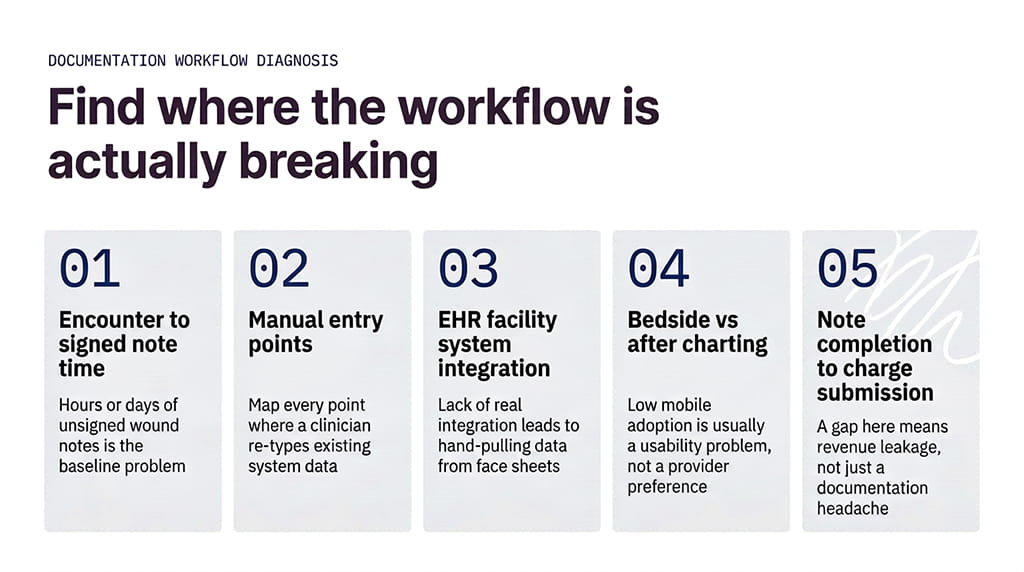
Diagnosing the Delay: 5 Questions Every Administrator Should Ask
Bedside Charting Fixes the Problem Where It Starts
The single biggest lever for reducing wound documentation delay is getting the chart into the clinician's hands during the encounter not after it.
That's the entire premise behind DocNow's WoundNow app, purpose-built for wound assessments on a phone or tablet at the bedside. Photography, measurements, and treatment documentation happen in the same interface, in real time, with no separate syncing step. Measurements and prior findings carry forward automatically into the next week's assessment, so clinicians are reviewing and editing, not starting from a blank chart every visit.
Because WoundNow integrates directly with the DocNow portal, there's no lag between what happens at the bedside and what shows up in the full chart. Desktop and mobile stay in sync without anyone touching a keyboard twice.
Templates That Match How Wound Care Actually Works
Generic EHR templates slow clinicians down in two directions such as being too rigid to fit a complex wound or too generic to capture what actually matters clinically.
DocNow's charting templates were built by post-acute providers, for post-acute workflows, with customizable layouts specialty teams can adapt to how they actually document not how a general-purpose EHR assumes they should. Reusable content and smart shortcuts cut down on repetitive typing, while the underlying structure still supports the clinical detail a wound assessment demands: stage, tissue characteristics, drainage, periwound condition, and a documented treatment plan.
Ambient AI: Taking the Typing Out of the Encounter
Manual typing is still the single biggest time sink in clinical documentation and it's one of the clearest drivers of after-hours charting. DocNow's DocSense brings both dictation and ambient AI directly into the EHR, so providers can either dictate a note with one click or let the system listen to the encounter and draft the note in the background while they focus on the patient.
DocSense writes directly into the same record the rest of the platform runs on, which means less copy-paste, fewer corrections, and a note that's closer to finished by the time the clinician walks out of the room.
Closing the Gap Between the Chart and the Bill
Every wound documentation delay eventually becomes a revenue problem. When charting and billing run on separate tracks, procedures get missed, codes get mis-keyed, and claims sit waiting on someone to chase down a provider for information that should have been captured automatically.
DocNow's charge capture is tied directly to the clinical note as a provider documents a wound care encounter, the relevant ICD-10 and CPT codes surface alongside it, and incomplete documentation gets flagged before the claim goes out. No separate coding sheet. No second system to reconcile. That's less time for billing teams spent chasing providers, and fewer dollars falling through the cracks between the chart and the claim.
Seeing the Bottleneck Before It Becomes a Backlog
None of this matters if administrators can't see it happening. Real-time dashboards inside DocNow surface unsigned notes, productivity trends, and compliance-relevant data at the provider and facility level so a documentation backlog shows up as a signal, not a surprise three weeks later during an audit.
Integrations That Remove the Manual Work Entirely
A lot of "documentation delay" is really just clinicians re-typing information the system should already have. DocNow integrates directly with PointClickCare and MatrixCare, syncing demographic and census data automatically so providers aren't reconstructing a patient's basic information from a face sheet at the start of every encounter. For teams managing billing separately, DocNow also connects with practice management and RCM platforms to keep coding and claims moving without a manual handoff.
The Real Cost Isn't Just Time — It's Burnout
Documentation burden is a leading contributor to clinician burnout. Post-acute providers who often round across multiple facilities with high patient volumes feel this strain most acutely. On average, providers on other EHR platforms report spending around six hours a day on documentation and administrative work. Providers using DocNow report cutting that closer to three.
That's not just an efficiency number. That's hours back in a clinician's day to actually be a clinician and a meaningful lever for retention in a workforce that's stretched thin.
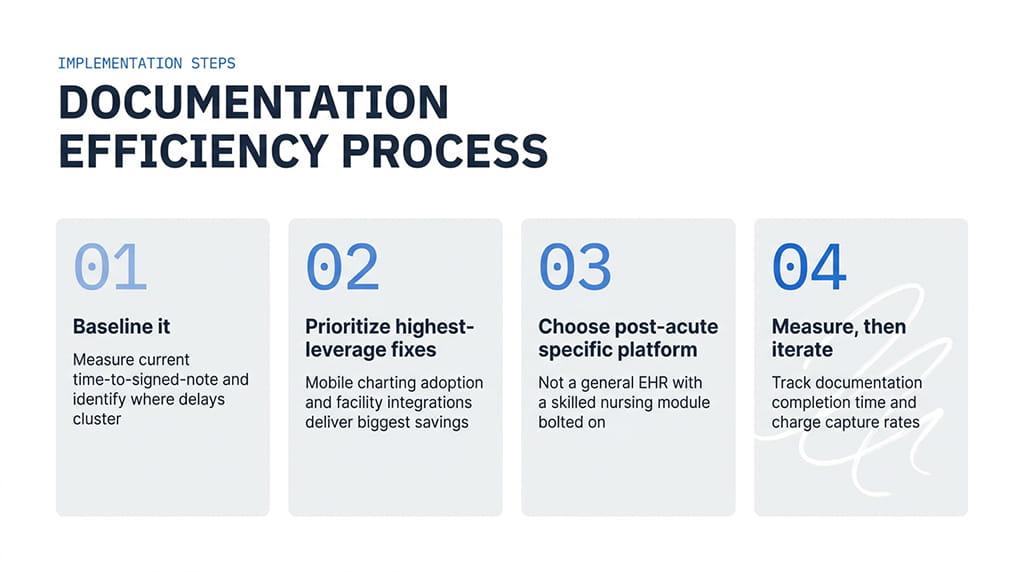
Building Your Documentation Improvement Plan
The Bottom Line
Wound care documentation will always require precision and that's not going away. What should go away is the duplicate entry, the disconnected systems, and the hours of after-hours charting that come from an EHR that wasn't built for how post-acute care actually works.
DocNow was built by providers, for providers, to bring bedside charting, wound-specific templates, ambient AI, facility integrations, and charge capture into one connected platform so documentation stops being the thing standing between clinicians and their patients.
FAQs: Reducing Wound Documentation Delays
What are the most common causes of wound documentation delays?
Disconnected EHR systems, weak mobile charting, generic templates that don't fit wound care, and manual data entry across multiple platforms. DocNow addresses each of these directly with bedside-first workflows and wound-specific templates built for post-acute care.
How does mobile charting reduce documentation delays?
It lets clinicians document during the encounter instead of on paper to be re-entered later. DocNow's WoundNow app supports this with real-time portal sync, integrated photo capture, and measurements that carry forward automatically.
What is ambient AI and how does it help wound care documentation?
Ambient AI listens to the patient encounter and drafts the clinical note in real time, so the clinician can focus on the patient instead of the keyboard. DocNow's DocSense offers both ambient AI and one-click dictation built directly into the EHR.
How do facility integrations improve documentation efficiency?
They pull patient demographics and census data in automatically instead of requiring manual entry from a face sheet. DocNow integrates directly with PointClickCare and MatrixCare.
What metrics should administrators track to spot documentation bottlenecks?
ime from encounter to signed note, unsigned note counts by provider and facility, and open charges awaiting documentation. DocNow's real-time dashboards surface these automatically.
How does integrated charge capture reduce revenue leakage in wound care?
By linking documentation directly to ICD-10 and CPT codes as the note is written, flagging incomplete documentation before claims go out instead of relying on a separate coding sheet after the fact.


