
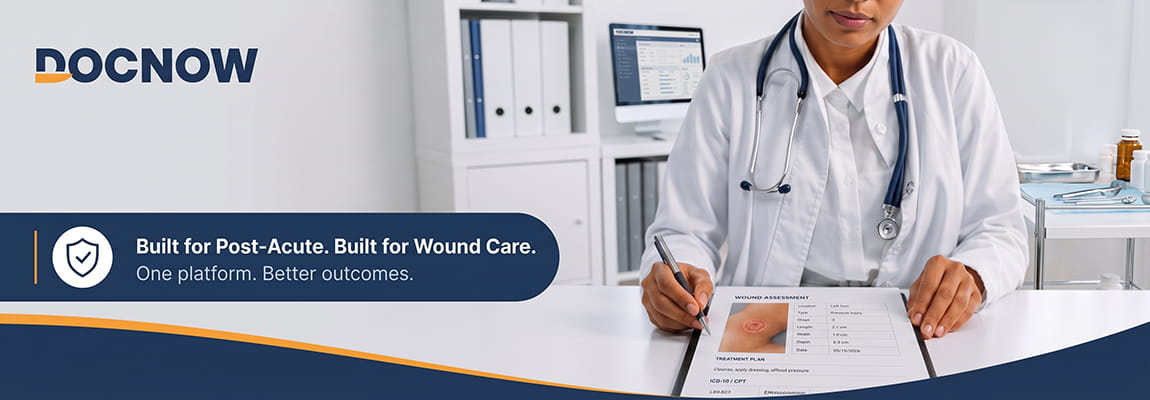
If you run wound care in a skilled nursing facility or long-term care setting, you already know the real bottleneck isn't the wound. It's the paperwork around it. A clinician can assess a stage 3 pressure injury at the bedside in five minutes and then lose twenty more to an EHR that wasn't built for wound care: re-typing measurements, hunting for the right ICD-10 and CPT codes, attaching photos that live in a separate app, and reconciling last week's note with this week's so the treatment plan actually tells a coherent story.
That gap between clinical work and clinical documentation is where post-acute care loses time, revenue, and eventually good clinicians. This guide breaks down where wound care documentation typically breaks down inside a general-purpose EHR, and what a system actually built for post-acute, specialty-aware charting looks like when it's done right.
Why Wound Care Breaks Generic EHRs
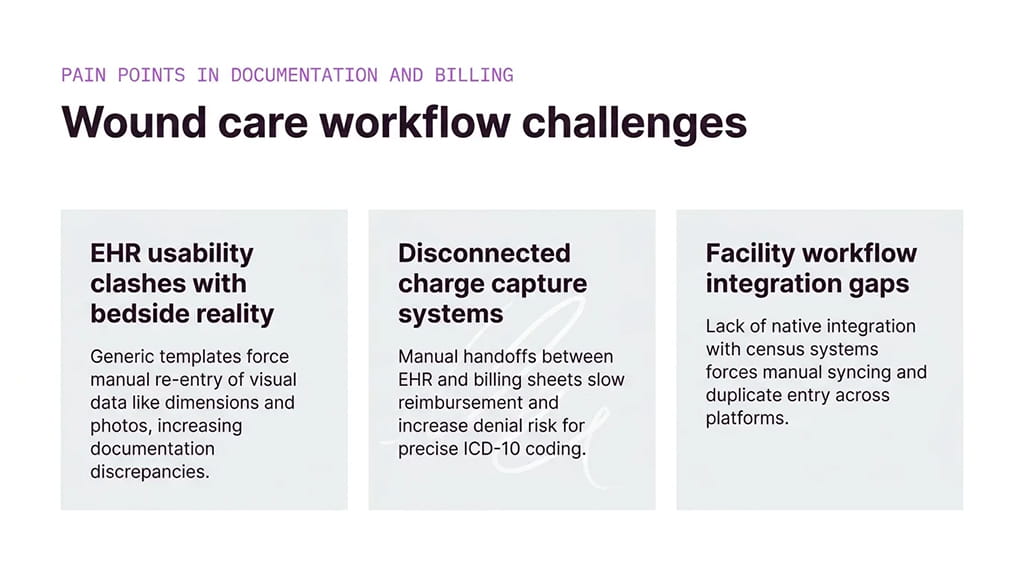
Most EHR platforms in long-term care were designed around inpatient or ambulatory workflows first, with wound care bolted on later. That mismatch shows up in three predictable places.
Diagnosing Your Own Bottlenecks
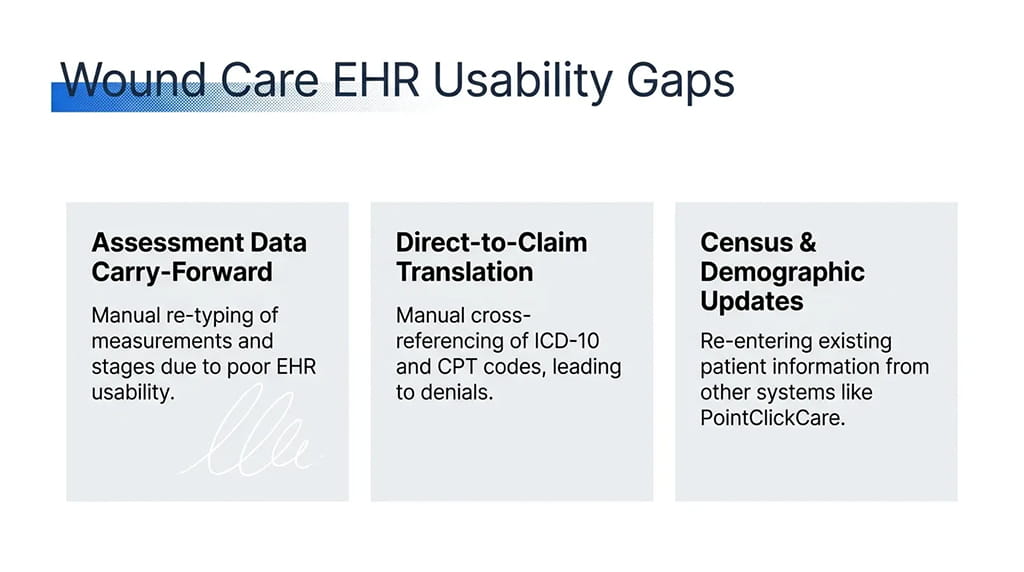
Before evaluating new software, it's worth auditing where your current workflow actually loses time. Three gaps tend to surface the real problem fast. Any manual work in these areas is a signal that the EHR, not the clinician, is the bottleneck.
What a Post-Acute EHR for Wound Care Should Actually Do
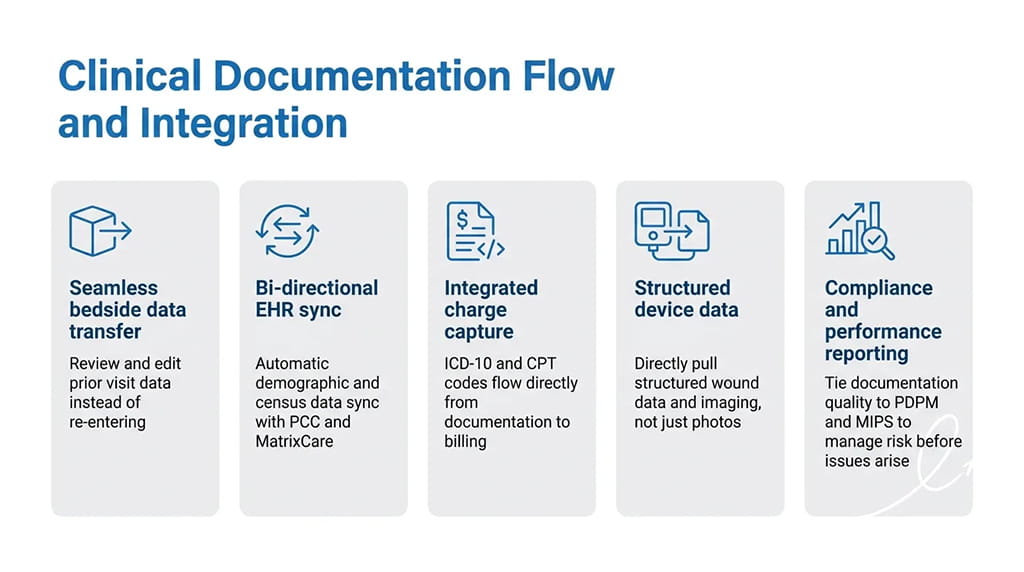
A wound care-ready EHR should be judged on whether it removes these manual steps, not just whether it has a wound care "module." This is the real healthcare software evaluation criteria for wound care: not feature lists, but how much manual translation work disappears between the bedside and the bill.
Where DocNow Fits
This is exactly the gap DocNow was built to close. DocNow's Wound Care module, delivered through the WoundNow app, was designed so bedside documentation — photography, measurements, and treatment notes carries forward week to week automatically, which is the single biggest fix for the documentation-discrepancy problem described above. Assessment data flows in real time between the mobile app and the DocNow portal, so there's no re-keying between a device and a chart.
On the charge capture side, DocNow connects wound documentation directly to the ICD-10 and CPT codes clinicians actually use, and to billing systems, so facilities aren't running separate coding sheets alongside the clinical record. That same native integration extends to PointClickCare and MatrixCare for census and demographic data, and to device partners like MolecuLight, Kent Imaging, and Mimosa for wound imaging so the workflow design problem (systems that don't talk to each other) is addressed at the integration layer, not patched over with manual entry.
DocNow has also brought DocSense, its ambient AI and voice dictation engine, into the same platform. For wound care specifically, that means providers can dictate an assessment or let Ambient Mode listen to the encounter and populate the chart automatically narrowing the time between the bedside exam and a complete, billable note even further. Because DocSense is built natively into the EHR rather than bolted on as a third-party overlay, there's no copy-paste step between dictation and the chart.
The net effect is a platform where wound care documentation, charge capture, and reporting live in one system instead of three: the chart, the coding sheet, and the census spreadsheet. For administrators doing an EHR system comparison, that consolidation is the practical difference between a tool that adds clinical efficiency and one that just adds another login.
Making the Fix Stick
Fixing a wound care documentation bottleneck isn't a one-time software swap, it's an ongoing discipline of checking whether your system is removing manual steps or just relocating them. The facilities that get the most out of a post-acute EHR for wound care are the ones that hold their platform to a simple standard: does this reduce the number of times a clinician has to type the same information twice? If the answer is consistently yes, documentation stops being the bottleneck, and wound care goes back to being about the patient in the bed, not the screen at the desk.
If you're evaluating whether your current EHR is actually built for post-acute wound care, or just adapted for it, DocNow's team can walk through what a native, integrated workflow looks like for your facility.
Ready to Get Started?
DocNow Post-Acute EHRs is live and ready to simplify your prescribing. If you're a DocNow customer, it's time to see how easy prescribing can be.
REQUEST A DEMO


