
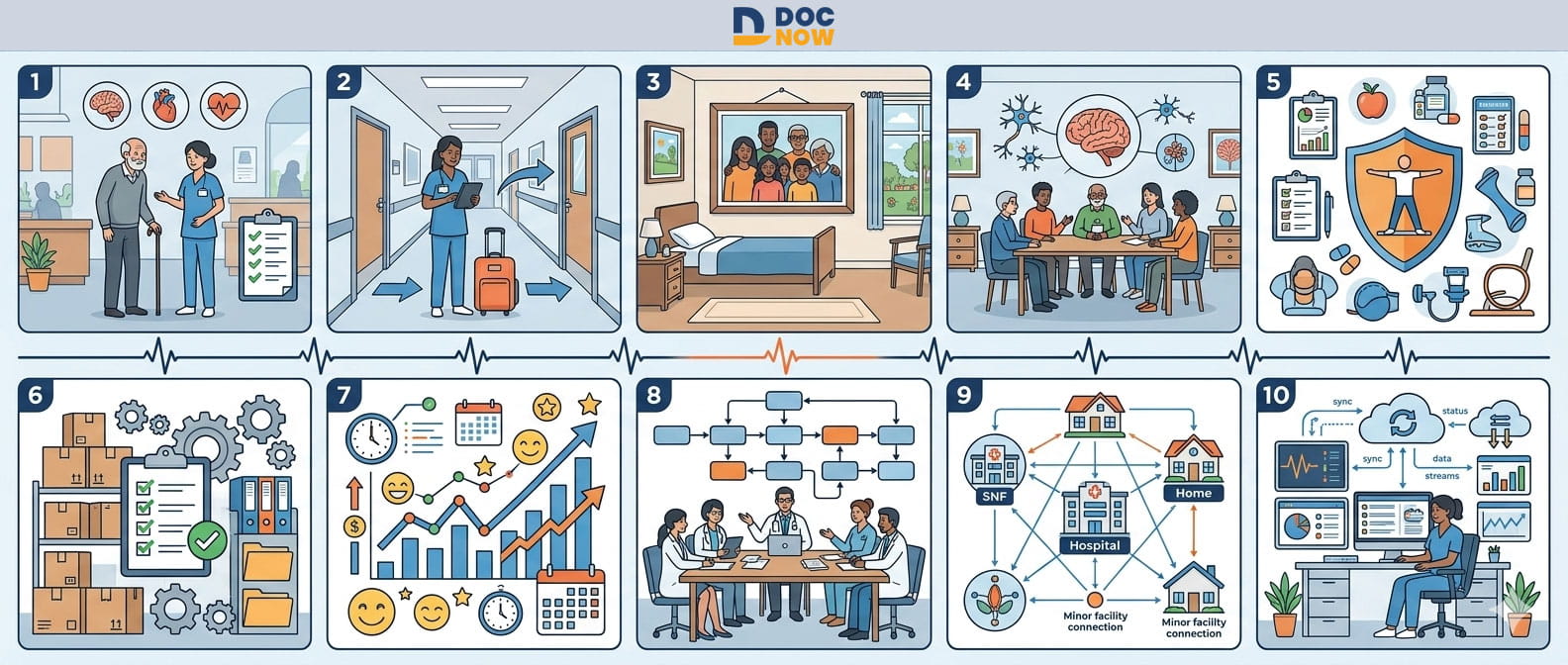
Why Post-Acute Behavioral Health Workflows Require Specialized Technology
Behavioral health providers working in skilled nursing facilities (SNFs), long-term care (LTC), and post-acute environments operate in a fast-moving, highly collaborative care setting that most traditional EHR systems were never designed to support.
Providers are expected to:
- Document efficiently across multiple facilities
- Coordinate with nursing and therapy teams
- Manage psychotropic medications and GDR workflows
- Maintain compliance readiness
- Capture charges accurately
- Reduce documentation burden while improving patient care
Unfortunately, many behavioral health organizations still rely on disconnected or outdated systems that slow clinicians down and create unnecessary administrative work.
As behavioral health services continue to expand across post-acute care, organizations are increasingly looking for platforms purpose-built for the realities of SNF behavioral health workflows.
Below are 10 common reasons behavioral health providers outgrow traditional EHR systems in post-acute care settings — and what organizations should look for in a modern platform.
1. Traditional EHRs Are Not Designed for Multi-Facility Rounding
Behavioral health providers in SNFs often travel between multiple facilities every day.
Many legacy EHR systems struggle to support:
- Mobile workflows
- Fast patient access
- Cross-facility rounding
- Bedside documentation
- Efficient chart navigation
This creates workflow friction that slows providers down throughout the day.
What to Look For
Modern post-acute behavioral health platforms should support:
- Mobile-first workflows
- Tablet optimization
- Multi-facility patient management
- Fast bedside documentation
- Efficient cross-facility navigation
Technology should support provider mobility — not create operational bottlenecks.
2. Documentation Workflows Create Too Much Administrative Burden
Behavioral health providers often spend excessive time completing:
- Psychiatric evaluations
- Progress notes
- Behavioral observations
- Medication reviews
- Compliance documentation
Many systems rely on rigid templates and repetitive workflows that increase documentation fatigue.
What to Look For
Modern behavioral health EHR systems should provide:
- Flexible documentation templates
- Smart shortcuts
- Auto-populated fields
- Streamlined workflows
- Faster note completion
Reducing documentation friction improves both efficiency and clinician satisfaction.
3. GDR and Psychotropic Medication Workflows Are Difficult to Manage
Behavioral health providers in SNFs frequently participate in psychotropic medication reviews and Gradual Dose Reduction (GDR) initiatives.
Without structured workflows, organizations may struggle with:
- Medication tracking
- Behavioral monitoring
- Compliance documentation
- Audit readiness
- Interdisciplinary coordination
What to Look For
A modern behavioral health platform should support:
- Structured GDR workflows
- Psychotropic medication visibility
- Behavioral tracking
- Medication review documentation
- Compliance-focused reporting
Efficient GDR workflows help organizations improve consistency while reducing administrative burden.
4. Behavioral Health Data Is Often Disconnected From the Rest of the Care Team
Behavioral health providers work closely with:
- Nursing staff
- Therapy teams
- Facility administrators
- Medical directors
- Social workers
When systems are disconnected, communication gaps can impact care coordination and operational efficiency.
What to Look For
Healthcare organizations should prioritize platforms that support:
- Interdisciplinary coordination
- Shared workflow visibility
- Centralized patient information
- Integrated care collaboration
- Secure behavioral health documentation access
Strong coordination workflows improve both patient care and operational performance.
5. Legacy Systems Slow Down Mobile Documentation
Many behavioral health providers still struggle with:
- Slow tablet performance
- Excessive clicking
- Difficult bedside workflows
- Frequent login interruptions
- Poor touchscreen usability
These issues become even more problematic during high-volume facility rounding.
What to Look For
A strong post-acute behavioral health EHR should include:
- Responsive mobile workflows
- Fast chart access
- Streamlined navigation
- Tablet-friendly interfaces
- Efficient bedside documentation tools
Mobile usability is critical in modern SNF behavioral health workflows.
6. Duplicate Documentation Wastes Valuable Time
Behavioral health providers are often forced to document the same information across:
- Psychiatric notes
- Facility systems
- Billing workflows
- Compliance records
- Medication documentation
Duplicate charting increases workload and contributes to clinician burnout.
What to Look For
Modern platforms should support:
- Shared documentation workflows
- Smart data reuse
- Integrated billing and charting
- Reduced duplicate entry
- Workflow automation
Reducing repetitive documentation improves speed and consistency.
7. Charge Capture Workflows Are Too Manual
Behavioral health billing workflows can become inefficient when documentation and charge capture are disconnected.
This may lead to:
- Missed billing opportunities
- Coding inconsistencies
- Delayed claims
- Revenue leakage
What to Look For
Organizations should evaluate:
- Integrated charge capture workflows
- Documentation-linked billing
- Coding support tools
- Real-time workflow visibility
- Incomplete documentation alerts
Efficient workflows help improve both operational and financial performance.
8. Reporting and Operational Visibility Are Limited
Behavioral health leadership teams need visibility into:
- Provider productivity
- Documentation completion
- Facility performance
- GDR tracking
- Billing trends
- Workflow bottlenecks
Many traditional systems offer limited reporting capabilities.
What to Look For
Modern behavioral health EHR platforms should include:
- Productivity dashboards
- Workflow analytics
- Documentation tracking
- Compliance reporting
- Operational insights
Visibility helps organizations improve efficiency and scalability.
9. Compliance Workflows Are Increasingly Complex
Behavioral health providers in post-acute care environments face growing regulatory pressure around:
- Psychotropic medication management
- Behavioral documentation
- GDR initiatives
- Audit readiness
- Quality reporting
Disconnected workflows often create additional administrative burden for clinicians.
What to Look For
Healthcare organizations should prioritize:
- Structured documentation
- Compliance-focused workflows
- Reporting automation
- Audit support tools
- Standardized behavioral health templates
Reducing compliance-related friction helps improve operational performance and provider satisfaction.
10. Providers Need Ambient AI and Dictation Workflows
One of the biggest emerging opportunities in behavioral health documentation is ambient AI technology.
Many providers still spend hours manually typing notes after rounds or completing documentation late into the evening.
This contributes to:
- Documentation fatigue
- Clinician burnout
- Reduced patient interaction time
- Slower workflows
What to Look For
Modern behavioral health platforms are increasingly incorporating:
- Voice dictation
- Speech-to-text workflows
- Ambient AI documentation
- Automated note generation
- Intelligent workflow assistance
These technologies can help behavioral health providers document more naturally while reducing administrative burden and improving documentation efficiency.
For post-acute behavioral health organizations, ambient AI workflows may play a major role in improving scalability and clinician satisfaction over the next several years.
Choosing the Right Behavioral Health EHR for Post-Acute Care
Not all behavioral health EHR systems are built for the realities of SNF and post-acute care environments.
When evaluating platforms, organizations should prioritize:
- Mobile usability
- Multi-facility workflows
- GDR support
- Interdisciplinary coordination
- Documentation efficiency
- Charge capture workflows
- Compliance readiness
- Ambient AI capabilities
The right platform can help behavioral health providers improve operational performance, reduce documentation burden, and support better patient care delivery.
Final Thoughts
Behavioral health providers in skilled nursing and post-acute care settings face increasingly complex operational and clinical demands.
Organizations relying on outdated or disconnected systems may experience growing challenges around workflow efficiency, compliance management, and clinician burnout.
Modern EHR platforms purpose-built for post-acute behavioral health workflows can help organizations streamline documentation, improve interdisciplinary coordination, support GDR initiatives, and reduce administrative burden — while enabling providers to spend more time focused on patient care.
Ready to Get Started?
DocNow Post-Acute EHRs is live and ready to simplify your prescribing. If you're a DocNow customer, it's time to see how easy prescribing can be.
REQUEST A DEMO


