
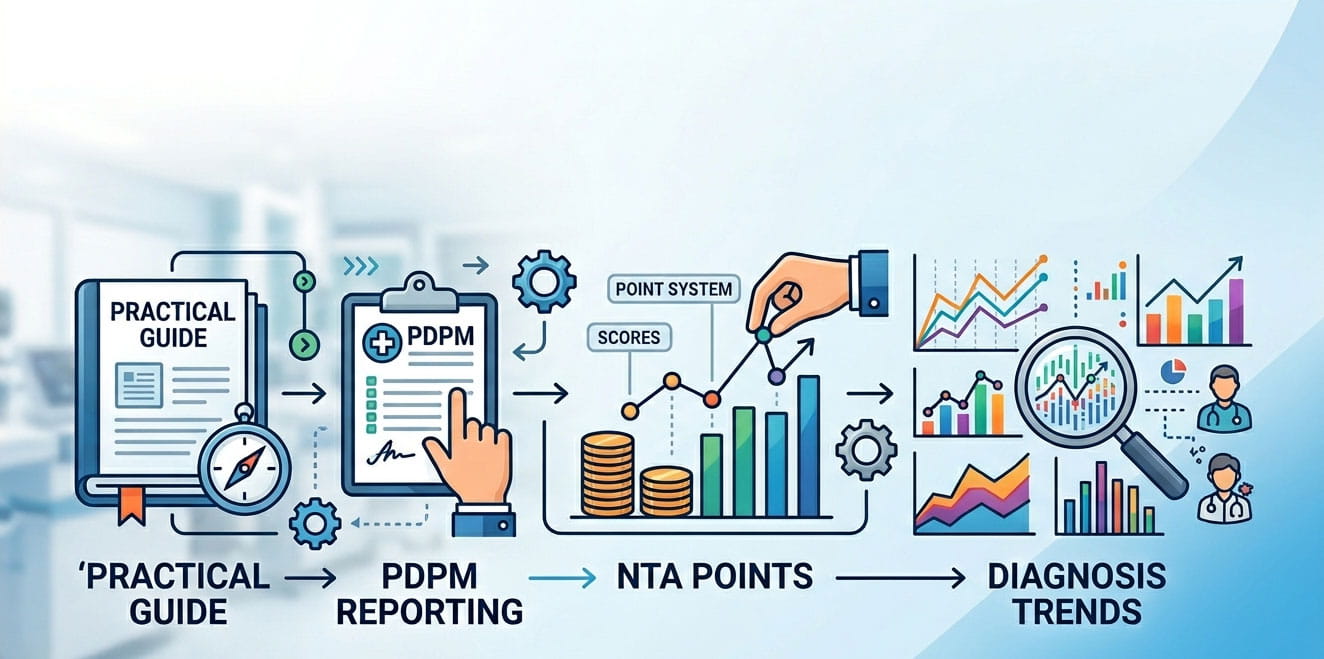
The Patient-Driven Payment Model (PDPM) has fundamentally changed how post-acute care providers, including Skilled Nursing Facilities (SNFs), are reimbursed.
Instead of therapy volume, reimbursement is now driven by patient complexity and documented diagnoses. For physiatry groups operating in the post-acute setting, this shift creates a new challenge:
How do you actually understand how your documentation contributes to PDPM?
Most post-acute organizations track diagnoses—but few have clear visibility into how those diagnoses influence PDPM components like Non-Therapy Ancillaries (NTA), Nursing, and Speech Therapy.
This is where PDPM reporting for post-acute care becomes essential.
What Is PDPM Reporting?
PDPM reporting in the post-acute care environment refers to the analysis of ICD-10 diagnosis data to understand how documented conditions contribute to PDPM scoring components.
For post-acute physiatry providers, PDPM reporting helps answer questions like:
- Which diagnoses contribute to NTA scoring?
- How do diagnosis patterns vary across post-acute facilities?
- Are certain patient populations driving higher PDPM components?
- How consistent is documentation across providers in post-acute settings?
Rather than focusing only on billing, PDPM reporting provides visibility into diagnosis patterns and clinical complexity across post-acute care environments.
Why PDPM Matters in Post-Acute Care
PDPM is specifically designed for the post-acute care setting, where patient complexity varies significantly across facilities.
For physiatry groups operating in post-acute environments, this introduces several challenges:
Limited Visibility Into Diagnosis Trends
Most post-acute EHR and billing systems show codes, but not patterns across facilities.
Difficulty Understanding NTA Contribution
NTA points are one of the most impactful PDPM components in post-acute care, yet many providers cannot easily see what's driving them.
Inconsistent Documentation Across Post-Acute Facilities
Different providers and facilities may document differently, creating variability in PDPM-related data.
Expansion of Medicaid PDPM Models
As more states adopt PDPM-based Medicaid reimbursement, post-acute providers need better visibility into diagnosis patterns.
Understanding NTA Points in Post-Acute PDPM
The Non-Therapy Ancillary (NTA) component plays a critical role in PDPM for post-acute care.
It captures high-cost conditions such as:
- Diabetes with complications
- Renal disease
- Infections
- Immune disorders
Each condition contributes points that influence PDPM components.
Why NTA Points Matter in Post-Acute Care
In the post-acute setting, NTA points:
- Reflect patient complexity
- Highlight clinically significant conditions
- Contribute to PDPM scoring components
However, many post-acute providers lack tools to clearly analyze:
- Which diagnoses contribute to NTA
- How frequently they occur
- How they vary across facilities
How PDPM Reporting Works in Post-Acute Settings
Modern PDPM reporting tools designed for post-acute care analyze diagnosis data tied to patient encounters and aggregate that information into facility-level insights.
1. Encounter-Level Analysis
Each patient encounter in the post-acute setting is evaluated based on:
- ICD-10 diagnoses
- Documented conditions
- Charge report data
This allows systems to calculate NTA Points Contributed.
2. Facility-Level Reporting
The data is then aggregated across post-acute facilities into reports showing:
- Total NTA points
- Diagnosis frequency
- PDPM-related diagnosis categories
- Trends across facilities and time
This provides a high-level view of PDPM-related diagnosis activity across post-acute operations.
What Insights Post-Acute Providers Gain
PDPM reporting helps post-acute organizations uncover patterns that are otherwise difficult to see.
Facility-Level Variation
Some post-acute facilities may show higher NTA contribution than others—even with similar patient populations.
Diagnosis Trends Across Post-Acute Settings
Certain ICD-10 categories may appear more frequently in specific facilities or regions.
Provider Documentation Patterns
Documentation practices can vary across providers working in post-acute care environments.
Population-Level Insights
Post-acute organizations can better understand how patient complexity varies across their network.
Common Use Cases in Post-Acute Care
Post-acute physiatry groups and SNF operators use PDPM reporting to:
Operational Reviews
Analyze diagnosis trends across post-acute facilities.
Documentation Awareness
Understand how diagnoses are documented across providers in post-acute care.
Leadership Reporting
Provide executive-level insights into PDPM-related diagnosis patterns.
Medicaid PDPM Preparation
Prepare for PDPM-based Medicaid models in post-acute environments.
What PDPM Reporting Does (and Does Not Do)
PDPM Reporting DOES:
- Analyze ICD-10 diagnosis patterns in post-acute care
- Calculate NTA Points Contributed
- Aggregate insights across post-acute facilities
- Highlight PDPM-related diagnosis trends
PDPM Reporting DOES NOT:
- Calculate SNF reimbursement rates
- Replace MDS systems
- Determine PDPM per diem payments
- Automatically detect missed diagnoses
Instead, it provides visibility into the diagnosis data driving PDPM components in post-acute care.
Why PDPM Reporting Is Essential for Post-Acute Providers
As PDPM continues to evolve, post-acute providers need better tools to analyze diagnosis data across facilities.
PDPM reporting enables:
- Improved visibility into diagnosis patterns
- Stronger understanding of clinical complexity
- Better internal reporting across post-acute operations
- Increased confidence in documentation trends
How DocNow Supports Post-Acute PDPM Reporting
DocNow provides PDPM reporting designed specifically for post-acute physiatry providers.
The platform:
- Analyzes ICD-10 diagnoses tied to post-acute encounters
- Calculates NTA Points Contributed
- Aggregates results across post-acute facilities
- Highlights diagnosis trends across patient populations
This gives post-acute providers a clearer understanding of how their documentation contributes to PDPM components.
Final Thoughts
PDPM has reshaped reimbursement across the post-acute care landscape.
For physiatry providers, success depends on:
- Understanding diagnosis patterns
- Analyzing NTA contribution
- Gaining visibility across post-acute facilities
PDPM reporting brings clarity to these areas—helping organizations better understand the data behind PDPM.
Want to see how PDPM reporting works in your post-acute organization?
Book a demo with DocNow to explore your diagnosis data and facility-level insights.
REQUEST A DEMO


